Nightblades
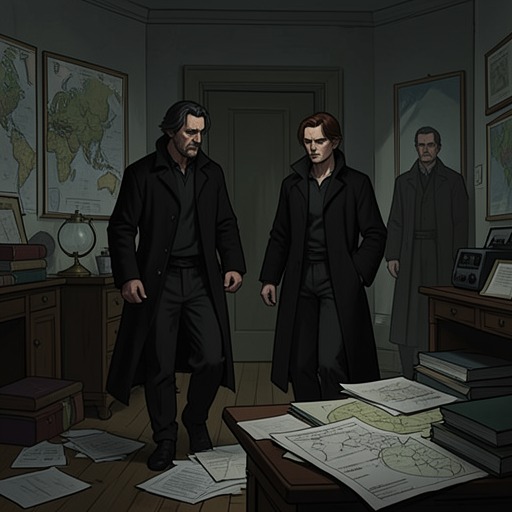
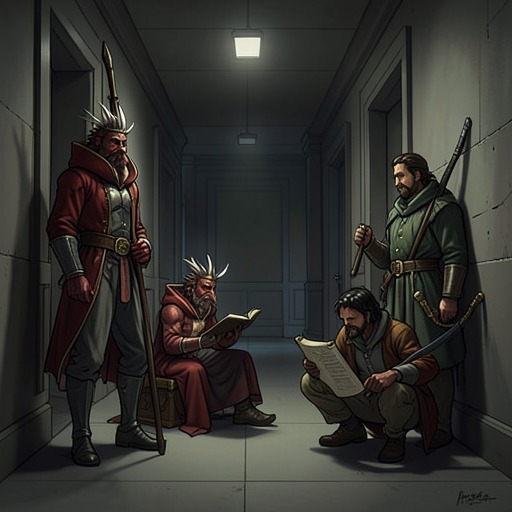
Vainqueur the DragonNightblades is an outlaw organization defined less by a public institution than by the marks, loyalties, and covert exchanges through which it moves across the world. Its black sword tattoo identifies its members, its operatives work as thieves and informants, and its influence reaches into the rival interests of Gardemagne and Ishfania. Through Victor Dalton, Savoureuse, and Lucie Lavere, the organization connects criminal expertise with espionage and political manipulation, making it one of the hidden structures surrounding the rise of Vainqueur Knightsbane.
Identity and Mark
Nightblades is presented as an organization outside legitimate civic authority. When Henry Bright notices the black sword tattoo on Victor Dalton's left shoulder, he immediately recognizes it as the mark of the Nightblades and understands the organization it represents. Victor attempts to describe the group as legitimate repossessors of private goods, claiming that he left when he became an adventurer, but the narration makes clear that this is a lie: no one truly leaves the Nightblades. The exchange establishes membership as a continuing danger rather than a past occupation that can be cleanly abandoned.
The tattoo is not confined to a single concealed location or a single kind of body. Victor bears it on his shoulder, while Savoureuse carries the Nightblades' black sword tattoo on the left side of her face. In her case, the mark is visible even while she travels in robes, carries potions and spices, and presents herself among the humanoid-looking monsters of Murmurin. The repeated image turns the black sword into a portable institutional signature. It identifies a shared past, but it also threatens exposure wherever its bearer goes.
Criminal Network and Skills
Victor Dalton's connection to the Nightblades is inseparable from his earlier life as a professional thief. When he meets Savoureuse again, he remembers that she had briefly been his friend and had shown him the tricks of the trade. Their reunion therefore reveals the organization not merely as a remote criminal name but as a practical school of illicit expertise, where skills and personal connections pass between members.
Victor's attempt to conceal his affiliation from Henry Bright shows the social cost of that expertise. He does not openly confess his former role; instead, he offers a deliberately softened account and warns Henry to remain silent. The warning carries more weight because Victor knows that departure is not genuine or secure. The Nightblades' power lies partly in this lingering vulnerability: a former member can enter a new profession, serve a dragon, and become an adventurer, yet the old mark still has the capacity to endanger his new identity.
Savoureuse and Political Intelligence
Savoureuse demonstrates that Nightblades activity extends beyond theft. When Victor encounters her in Murmurin, she is a Lizardkin with sandy scales, fangs, claws, swept-back horns, a barbed tail, traveler robes, and a sash of potions and spices. Her appearance places her comfortably within the monster-populated settlement, but her tattoo and later disclosures reveal a second career as a political intermediary.
Savoureuse explains that fairy flowers allow her to walk under the sun, a gift from one of her teachers that she repays by carrying out politically minded tasks. Victor then connects her testimony to a larger chain of events: she had told him that the Nightblades supported the Scorchers and had handed Henry Bright over to Gustave La Muraille and François Vilmain. Her work has therefore affected both a military organization and the fate of a person close to Victor's world.
Her allegiance is deliberately conditional. Savoureuse admits that she sometimes works for Ishfania and sometimes for Gardemagne, while also reporting to Nostredame about Vainqueur Knightsbane's new empire. The Nightblades thus operate within a field of competing states rather than serving one permanent national master. Savoureuse does not intend to attack Vainqueur directly, recognizing that challenging a dragon would be foolish, but her restraint is itself politically useful: observation and selective cooperation can preserve the organization's access where open conflict would destroy it.
Lucie Lavere's Leadership
At the organization's highest revealed level stands Lucie Lavere, identified as the leader of the Nightblades and a vampire criminal mastermind. Her position gives the Nightblades a distinct command structure, even though much of its work remains decentralized and covert. She reports on the consequences of a mission involving the Hellgate, the dragons, Vainqueur Knightsbane, Maure, and Gardemagne, demonstrating that the organization can act inside conflicts far larger than ordinary criminal ventures.
Lucie Lavere reports that she destroyed the bindings of the Hellgate as ordered, while the dragons subsequently tore through Maure's army and Vainqueur claimed Ishfania with Gardemagne's support. Many of Vainqueur's guests also became adventurers, showing how rapidly the political landscape had changed. When questioned about why she had not assassinated Vainqueur's principal minions, Lucie answers that she had not been instructed to do so: her orders were limited to destroying the seals. Her defense reveals a disciplined, literal chain of command. The Nightblades may manipulate events, but their operatives distinguish sharply between assigned objectives and unauthorized escalation.
Lucie's relationship with Mell Odieuse further clarifies the organization's place within a wider conspiracy. Mell dismisses her but orders her to continue watching Vainqueur Knightsbane and Gardemagne until further services are required. The Nightblades are consequently used as an observing and interventionist instrument by a more secretive power, though Lucie remains a capable actor rather than a passive messenger.
Methods and Narrative Significance
Mell Odieuse's explanation of her own strategy describes the kind of political environment in which the Nightblades thrive. She fosters chaos from the shadows, empowering Maure with knowledge in the hope that Maure and Gardemagne will destroy one another and leave victory to the fomors. Lucie Lavere's surveillance and reports make the Nightblades part of that shadow system: they gather information, deliver people, support factions, and carry out precise acts whose consequences may exceed the original assignment.
The organization also stands in contrast to the increasingly public institutions surrounding Vainqueur Knightsbane. Victor Dalton becomes a chief of staff, helps register Vainqueur and himself as an adventurer company, and is burdened with administrative work in the emerging empire. Charlene manages requests and paperwork for the Gardemagne Adventurer Guild, while Vainqueur's servants recruit one hundred kobolds and other high-level monsters for war. Nethermart later opens as a public magic-item shop, and the Kobold Rangers and other servants gather openly around Vainqueur. Against these visible systems of paperwork, recruitment, commerce, and ceremony, the Nightblades retain an older and darker method: tattoos, secrets, favors, intelligence, and deniable action.
Its influence persists even as former or associated figures enter new roles. Victor's attempted escape from the Nightblades is undermined by the permanence of his mark; Savoureuse moves between criminal affiliation and international intelligence; and Lucie Lavere continues to serve as the organization's calculating representative amid the upheaval caused by dragons and war. The Nightblades therefore embody continuity beneath political transformation. Kingdoms may make treaties, monsters may become adventurers, and a dragon may claim an empire, but covert networks endure by converting personal history and hidden knowledge into power.